What Size Blower Do I Need for an Inflatable? HP, CFM, and Power Planning
Most commercial bounce houses run on a 1–1.5 HP blower moving roughly 800–1,200 CFM. Giant advertising inflatables above 6 m (20 ft) usually need 2–3 HP, or multiple blowers matched to internal volume. Below is the full sizing chart, the three numbers behind it, and the power planning that goes with it — from the production line at 360 Inflatable, where each custom build completes a 24-hour continuous inflation test on its matched blower set before packing.
What Size Blower Do I Need? Quick Chart by Inflatable Type
Find your inflatable type in the chart, then confirm the final figure against the manufacturer's specification for your specific unit. The chart assumes constant-air construction, standard Oxford or PVC fabric, and a blower mounted at the inlet.
| Inflatable type | Typical size | Recommended blower | Notes |
|---|---|---|---|
| Small bounce house | Up to 13 ft (4 m) | 1 HP, ≈800–1,000 CFM | Standard rental fleet unit |
| Large combo or water slide | 15–20 ft (4.5–6 m) | 1.5–2 HP | Longer air path needs more pressure |
| Advertising arch / tube man | Up to 20 ft (6 m) | 0.75–1 HP high-pressure | Small volume, high static pressure design |
| Giant custom character | 3–6 m (10–20 ft) | 1.5–2 HP | Sized to internal volume |
| Giant structure | 6–12 m (20–40 ft) | 2–3 HP or two blowers | Multi-chamber builds may need one blower per chamber |
| Over 12 m (40 ft) | Landmark scale | Multiple blowers | Calculated from volume and target pressure |
Three situations push a unit one class up the chart: a long duct between blower and inlet, all-day operation in summer heat, and any structure with separate air chambers. When your inflatable falls between two rows, take the larger class — a blower with headroom can be throttled down, while a maxed-out blower has nowhere to go.
Bounce Houses and Water Slides
Rental-grade bounce houses are the most standardized category. A 13 ft castle inflates properly on a 1 HP unit; a 15–20 ft combo or slide calls for 1.5–2 HP because the air has farther to travel and the slide surface must stay firm under load. Water slides add humidity at the intake, so the blower housing and motor rating matter as much as the horsepower figure.
Giant Advertising Inflatables
Custom brand inflatables follow different rules. Shape fidelity is the product: a mascot that sags at the shoulder or a product replica with a collapsed top reads as a brand incident, not a minor inconvenience. These builds are sized from internal volume and panel layout, and once the blower is chosen, connection, anchoring, and on-site power are covered in our step-by-step inflatable setup guide.
HP, CFM, and Static Pressure: What Actually Matters in an Inflatable Blower
Three numbers describe any inflatable blower, and buyers routinely over-read the first one:
- HP (horsepower) — motor input power. Useful as a rough class marker, misleading as a performance figure, because two 1 HP motors can move very different volumes of air.
- CFM (cubic feet per minute) — the volume of air the blower actually moves. This is the number that inflates your structure, and it falls as resistance rises.
- Static pressure — the resistance the fan can work against, from long air channels, small inlets, or dense fabric. Tall slides and complex character shapes need pressure as much as volume.
The sizing principle used for custom builds is simple to state: match the blower to the inflatable's internal volume and air-path resistance; generic kit thinking fails here. A 6 m character with narrow limbs behaves nothing like a 6 m dome; the first needs pressure to reach the extremities, the second needs raw CFM across a large shell. When the quotation starts from internal volume, the finished piece holds its shape from day one through week four of a campaign.
Do Sealed Inflatables Need a Blower? Constant-Air vs Sealed
Two construction types exist, and they have opposite power needs. Sealed (airtight) inflatables are welded closed and inflated once with a pump; they hold air for days or weeks with no power at all. Constant-air inflatables are sewn, leak by design, and need a blower running whenever the unit is up. Confusing the two is the most expensive sizing mistake a buyer can make — a sealed unit paired with a continuous blower gains nothing, and a constant-air unit without one collapses.
| Constant-air | Sealed (airtight) | |
|---|---|---|
| Air supply | Blower runs continuously | Inflated once, then disconnected |
| Power needed on site | Yes, for the whole display period | No |
| Power cut behavior | Loses shape within minutes | Stays up |
| Typical uses | Bounce houses, slides, arches, large characters | Helium-style shapes, water floats, small sealed displays |
Everything else in this guide assumes constant-air construction, which covers commercial rental equipment and most large advertising inflatables.
What Size Blower for a Bounce House vs a Giant Advertising Inflatable?
The rental industry and the brand-activation industry buy blowers for different reasons. Rental operators optimize for fleet standardization and transport weight. Brand buyers optimize for shape fidelity in front of a camera.
Is 1 HP Enough for a Standard Bounce House?
For a castle up to 13 ft, yes — 1 HP is the industry default and leaves margin. Past 15 ft, or with an attached slide or obstacle section, 1 HP runs at its limit and any leak or kinked inlet shows up immediately as soft walls. Step to 1.5 HP and the same unit stays firm with headroom for a hot afternoon when the air inside expands.
When Do You Need a 2 HP Blower?
Three situations justify 2 HP or more: large combination units over 15 ft, long water slides where the air path runs the full length of the structure, and any inflatable where the blower sits far from the inlet through an extended duct. The added draw is roughly 1,100–1,500 running watts, so the power plan has to move up a class at the same time.
Sizing Blowers for Giant Custom Inflatables
Large custom pieces add two variables the rental chart never sees. The first is internal volume: a 10 m product replica holds far more air than any bounce house, and the blower must replace what the seams and fabric release, continuously, at the pressure that keeps every panel taut. The second is chamber layout. A character with separate head, body, and limb chambers may need a dedicated blower per chamber so one deflated section never drags the whole figure down. On the production side this is decided at the pattern stage — air channels are designed into the piece, and the blower specification is written before the first panel is cut. Buyers of custom giant inflatables should expect the manufacturer to state the blower calculation behind the specification.
Multi-Blower Setups and Backup Planning for Large Inflatables
Once a structure passes roughly 8–10 m, or carries separate chambers, multiple blowers stop being optional. The reasons are practical:
- Pressure coverage — one inlet cannot push air evenly into a wide or tall structure; two or three inlets at engineered positions can.
- Redundancy — if one blower trips a breaker at a public event, the remaining units keep the structure standing while the circuit is reset.
- Noise and logistics — two mid-size blowers are quieter and easier to position than one very large unit.
Backup planning belongs in the same conversation. For rental fleets the standard is one spare blower per event. For brand activations the equivalent is a factory-verified margin: at 360 Inflatable, the final 24-hour inflation test at our factory runs the structure on its actual blower set, under continuous load, so the configuration that ships is the configuration that was proven. 
Structures are also rated for wind exposure — our standard giant builds are specified to 38 km/h — which tells the blower system how hard it may have to work when weather adds external pressure.
What Size Generator Do I Need for an Inflatable Blower?
Generator sizing trips up first-time buyers because a blower's nameplate horsepower hides two electrical facts: the motor draws more watts than the HP figure suggests, and it draws two to three times that amount for a second or two at startup. Work through four steps:
- Find running watts. Read the nameplate: amps × volts = watts. A typical 1 HP blower draws about 8 A at 115 V, roughly 900–950 running watts.
- Allow for starting surge. Multiply running watts by 2–3 for the first seconds of each start. That 1 HP unit can demand 1,800–2,500 W momentarily.
- Add headroom. Generators should not run above 75–80% of rated output for hours on end. Add 20–25% on top of the surge figure.
- Sum all loads. Two blowers, lighting, and a sound system on one generator add up faster than expected.
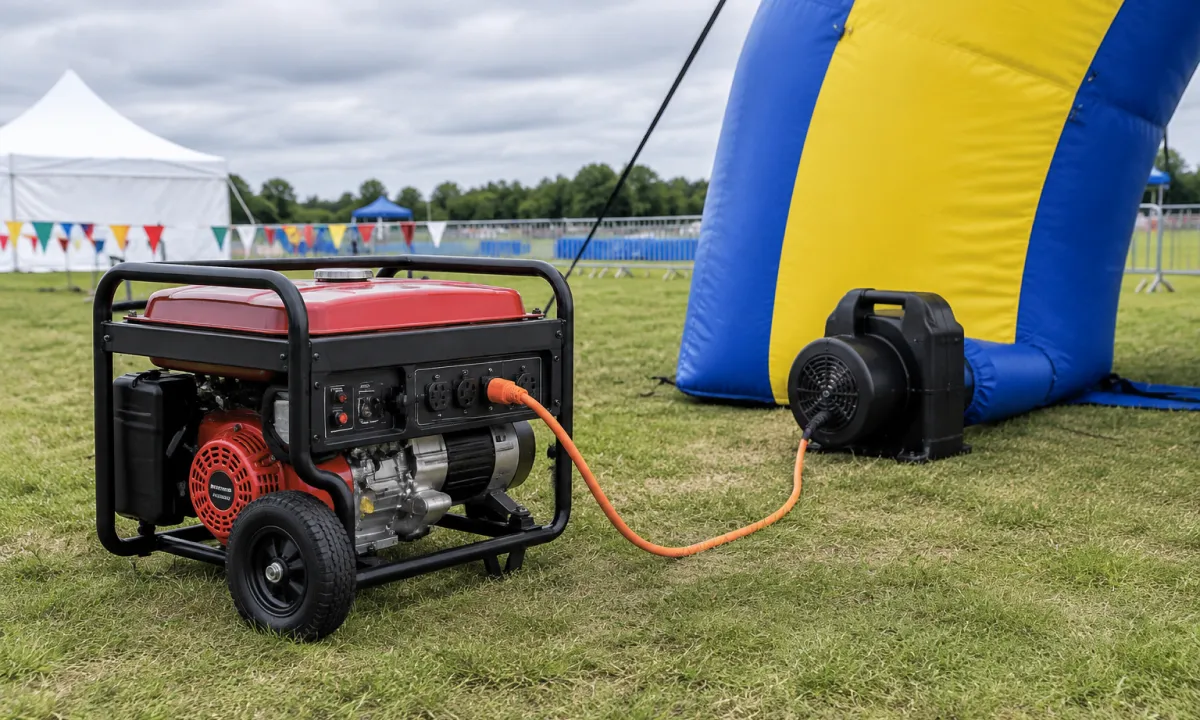
Worked example: a single 1 HP blower on a 2,000 W generator starts and runs, but with little room for anything else — the surge occupies nearly the whole rating. A 1.5–2 HP blower, or two blowers on one circuit, belongs on a 3,500 W class generator or larger. On site, keep cords short and thick: 12-gauge cable under 50 ft, connections off the ground, and GFCI protection anywhere near water or public foot traffic.
Buying for Export: 110V/220V, CE and UL Certification
Cross-border buyers face two extra checks that domestic guides skip. The first is the grid itself: North America runs on 110–120 V / 60 Hz, most of Europe, Asia, and the Middle East on 220–240 V / 50 Hz. A blower wound for one grid underperforms or overheats on the other, and a 60 Hz motor running on 50 Hz turns slower, which directly cuts CFM. The second is certification. Venues, insurers, and event organizers increasingly ask for CE or UL documentation on electrical equipment, and a blower without it can stall an installation approval.
Both points are solved at the specification stage, before anything reaches the site. A manufacturer exporting globally should ship blowers matched to the destination grid and certified for the destination market — 360 Inflatable's giant builds, for example, include continuous-run blowers in 110V/220V-compatible configurations with CE and UL certification as standard, so the electrical plan is settled before the crate is opened.
How Loud Is an Inflatable Blower? Noise and Indoor Use
Blower noise is a real planning constraint for indoor exhibitions, shopping malls, and evening events. Typical continuous-duty units measure around 65–75 dB at one meter in the 1 HP class — close to loud conversation — and 75–85 dB for 2–3 HP units, nearer to city traffic. Perceived noise drops quickly with distance and with simple barriers, and two smaller blowers placed apart usually sound less intrusive than one large unit at full tilt.
Three habits cover most indoor situations: position blowers behind the structure or a display wall, away from the audience; keep intake grills unobstructed so the motor never labors; and specify low-noise housings at order time when the venue is known to be enclosed. Retrofitting quiet operation after delivery is far harder than ordering it.
Blower Maintenance Basics
A continuous-duty commercial blower lasts for years of regular use when three habits hold: keep the intake clear of grass, fabric, and packaging film; store the unit dry with the cord coiled loosely; and inspect cables and plugs before each event — a fault found on site is found too late. Filters and housings deserve a wipe-down on the same schedule as the inflatable itself. The full care routine — cleaning, drying, folding, and off-season storage for blower and structure together — is laid out in our inflatable maintenance and storage guide.
Planning a custom build? Blower selection starts in the design file, not at the warehouse. Send us your concept, dimensions, and venue conditions, and the engineering team will return a matched blower specification — sized to internal volume, certified for your market, and verified on a 24-hour continuous test before anything ships.
FAQ
Yes. Excess pressure stretches seams and fabric, adds noise, and wastes electricity. Match the blower to the manufacturer's specification; a slightly larger unit is acceptable only when its airflow can be throttled down to the design pressure.